Generator
Turning mechanical motion into electrical power.
A conceptual cross-section: the magnetic rotor turns within the wound stator, driven by a shaft. Real winding and pole arrangements vary.
A rotating generator converts mechanical energy into electrical energy through electromagnetic induction. A turbine or another prime mover supplies the mechanical input.
A rotating field and stationary windings
In a common synchronous generator design, the rotor carries a magnetic field and turns inside a stationary stator. The changing field induces alternating voltage in the stator windings. A turbine or another prime mover supplies the mechanical energy.
The simplified cross-section shows the principle rather than every component. Real machines also need bearings, cooling, insulation, excitation, and controls. A generator converts energy; it does not create energy from nothing.
Why it matters
Rotating generators connect mechanical energy from wind, flowing water, steam, or engines to the electrical system.
In the field
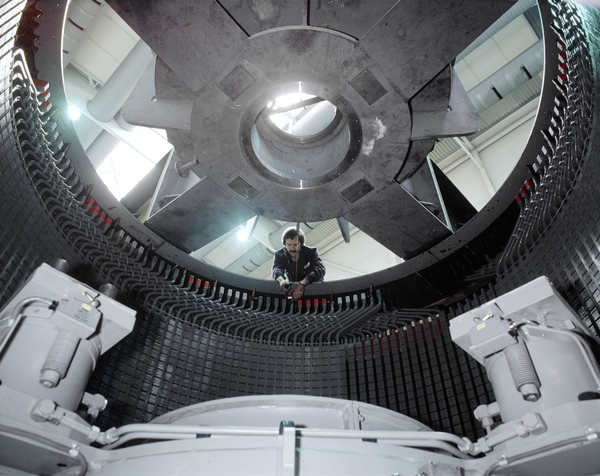
Assembly of a generator stator frame at the NEBB works in Oslo in 1982. The scale of the stationary structure is easier to appreciate during manufacture.
Atelier Rude. Unknown photographer. · CC BY 3.0 (resized)