Transformer
A change of voltage. A key part of every electricity journey.
A simplified outdoor power transformer: insulated terminals above, a tank and cooling surfaces below.
A transformer transfers energy through magnetic coupling between windings. It can raise or lower an alternating voltage, or provide electrical isolation between circuits.
Changing voltage through a magnetic field
Inside a transformer, an alternating current in one winding creates a changing magnetic field. That field induces a voltage in another winding. The ratio of turns in the windings largely determines the ratio of their voltages. An isolation transformer may keep approximately the same voltage on both sides.
A large grid transformer is more than its windings: the enclosure, insulating bushings, cooling equipment, and protection all matter. The radiator fins visible on many outdoor units help carry away heat.
Why it matters
Transformers let different parts of an AC network operate at different voltages. They make it practical to transmit power at high voltage and deliver it at lower voltages near customers.
In the field
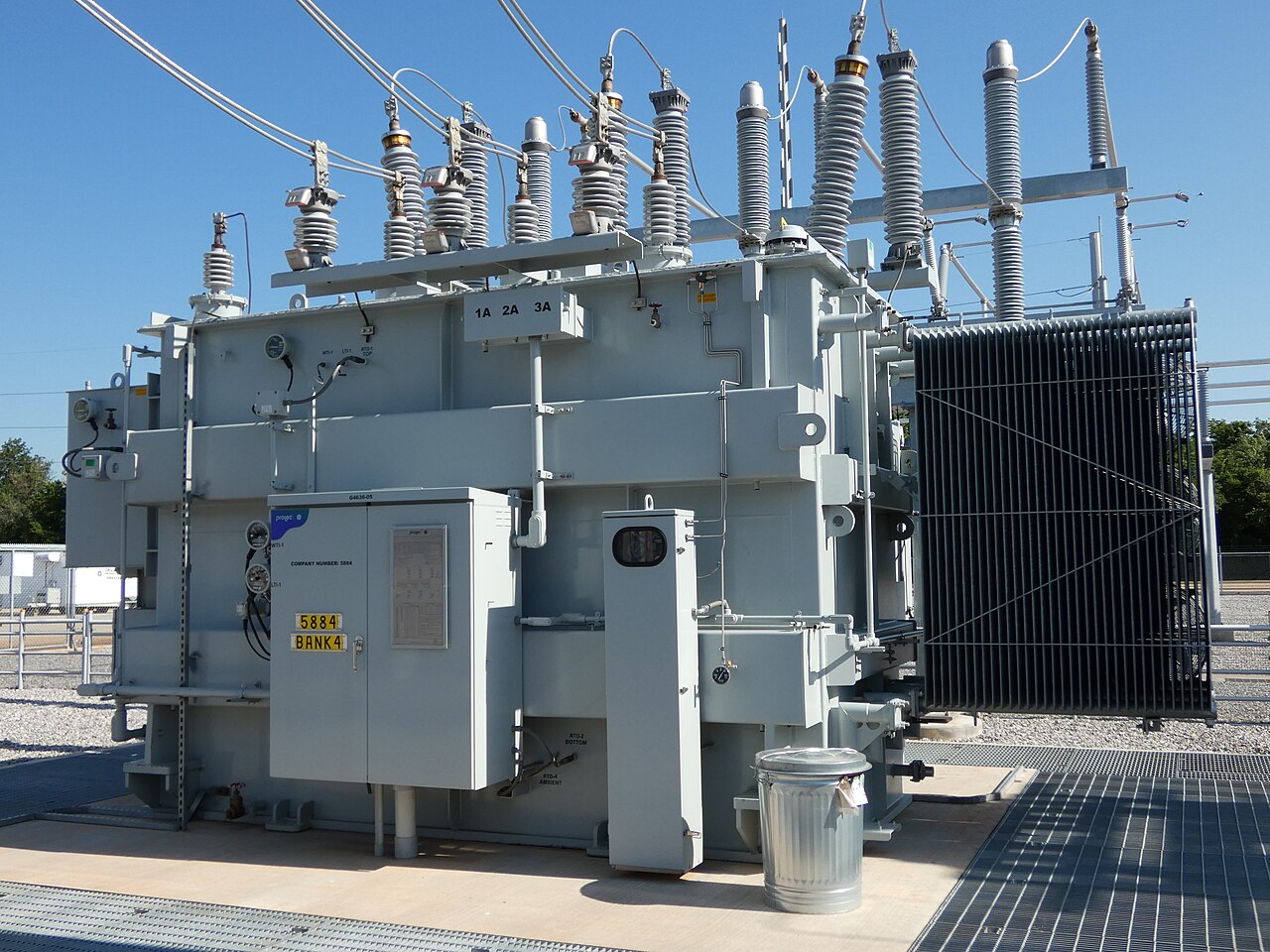
A substation power transformer rated 138 / 12.5 kV. The tank, cooling equipment, and insulated connections give the schematic a physical scale.
Yoshieslunchbox · CC BY-SA 4.0 (resized)