Transmission
The high-voltage backbone that connects places and power.
Overhead transmission conductors hang from insulator strings on a steel lattice tower.
Transmission networks move bulk electrical power between generators, regions, and major substations. For a given power transfer, using higher voltage reduces current and resistive losses. Transmission can use AC or DC, with overhead lines or underground cables.
Moving bulk power between places
A transmission network links large generators, major substations, and neighboring regions. Its lines can span long distances, but distance alone does not define transmission: their role in the wider network matters too.
For a given real power and power factor in an AC circuit, higher voltage means lower current. Resistive losses follow I²R, so lower current reduces those losses for the same resistance. Line ratings still depend on the conductors, clearances, weather, and other constraints.
Why it matters
Strong transmission connections let regions share resources and move electricity from where it can be generated to where it is needed.
In the field
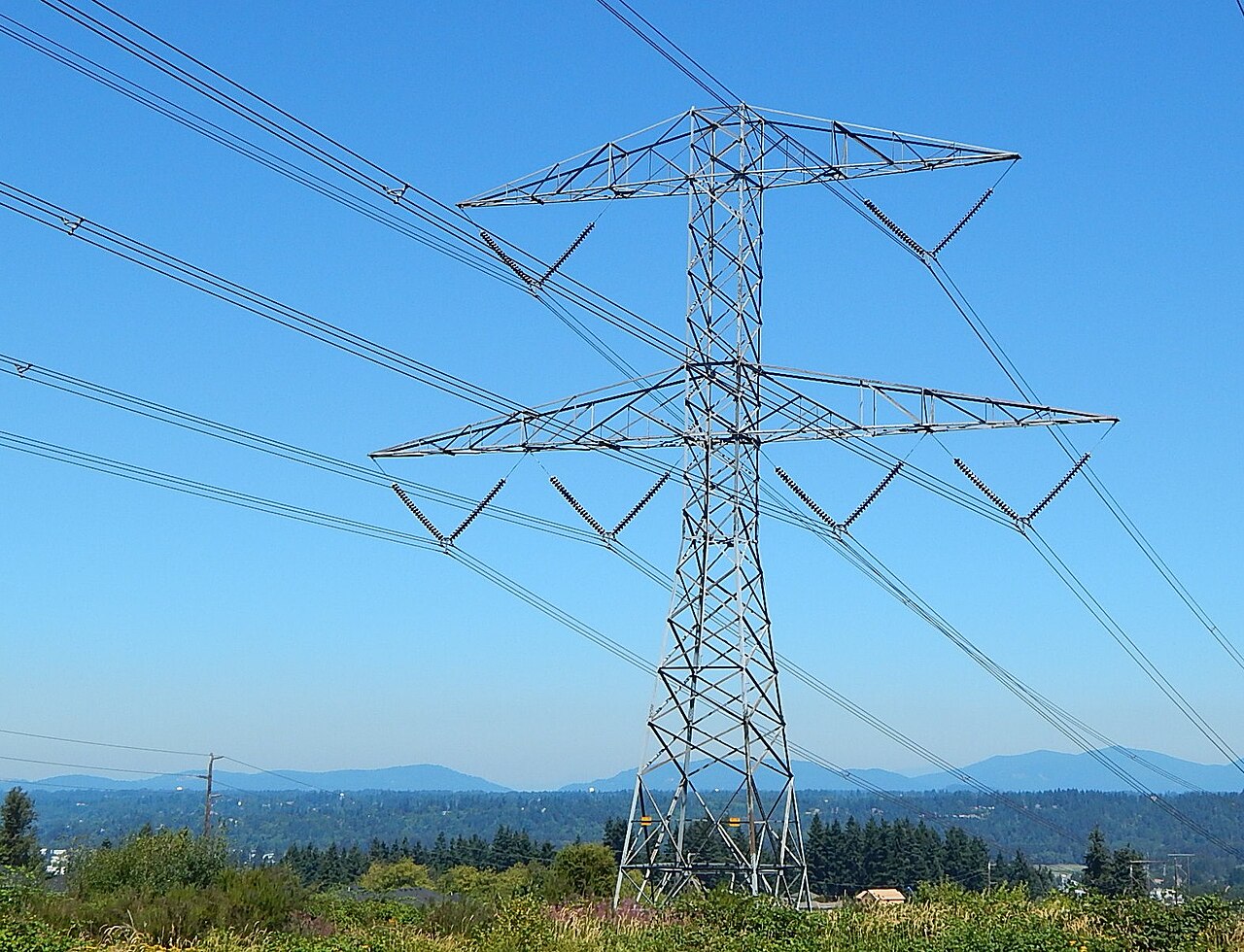
A high-voltage transmission tower and its suspended conductors in Auburn, Washington. Insulator strings separate the energized wires from the steel structure.
Ron Clausen · CC0 (resized)